

La version française est disponible.
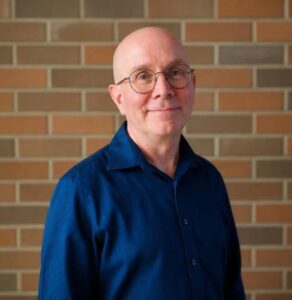
When Éric Hébert-Daly reflects on his time at United Theological College, now part of the integrated Dio community, one word comes to mind: innovation.
A 2019 graduate of United Theological College and recently appointed General Secretary of The United Church of Canada, Hébert-Daly credits his theological education with helping him embrace both tradition and change. The lessons he learned as a student continue to shape his approach to ministry, leadership, and the future of the church at a national level. As churches across Canada wrestle with questions about relevance, community, and mission, Hébert-Daly believes the answer lies not in abandoning tradition, but in learning how to engage it creatively.
For Hébert-Daly, theological education provided more than academic knowledge. It offered a framework for understanding ministry in a rapidly changing world. “I got both a sense of the traditional,” he explains, “and tools to think about things differently and to try new things.” That combination proved invaluable. On one hand, he gained the foundations needed to serve within established congregational settings. On the other, he was encouraged to explore innovative approaches to ministry and church life. The balance between tradition and experimentation would become an important theme throughout his career. Looking back, he sees those years as a period of formation that prepared him for leadership far beyond the local congregation.
As Hébert-Daly’s ministry evolved, he moved beyond congregational settings into regional and national leadership roles. That transition revealed the importance of thinking creatively about the church’s future. The challenges facing contemporary churches are complex and often unfamiliar. Traditional models that served previous generations do not always address the realities of today. Yet Hébert-Daly believes theological education helped him challenge assumptions and imagine new possibilities. “The vision we’re casting for the future of the church is a very different way of thinking about things,” he says. Rather than focusing exclusively on administration or institutional maintenance, he argues that church leaders must remain grounded in theological reflection while also being willing to innovate. For him, leadership involves helping communities discern where God is at work and how the church can respond faithfully.
One course in particular left a lasting impact on Hébert-Daly’s ministry. A course on Christian education and formation, taught by Allison Huntley, introduced him to new ways of thinking about leadership, learning, and community engagement. The class explored how leaders can cast vision, generate excitement, and invite people into meaningful participation. More importantly, it challenged students to think about formation not simply as transferring information, but as helping people discover new possibilities for spiritual growth and action. The lessons have remained with him throughout his career. “It opened up a lot of possibilities,” he recalls. Today, those same skills continue to influence his work as a church leader, helping him engage communities around questions of identity, purpose, and mission.
Hébert-Daly believes that one of the greatest challenges facing churches today is remaining grounded in their theological foundations. It can be easy, he notes, for church leadership to become consumed with practical concerns, governance issues, budgets, and organizational structures. While those matters are important, they are not the church’s primary purpose. “We need to bring ourselves back to the theological underpinnings,” he explains. “The foundation of our faith and what it means to be a Christian in this world.” For Hébert-Daly, faithful leadership requires continually reconnecting institutional decisions with the deeper spiritual questions that give them meaning. That perspective has become increasingly important as church leaders attempt to navigate rapid cultural and social change.
Much of Hébert-Daly’s current work involves thinking about the future. What will the church look like in 2035? How can Christians respond to emerging realities? How can communities of faith remain vibrant and relevant in a changing society? Rather than offering simple answers, he invites people into a process of collective discernment. He speaks of becoming “co-creators with God” in shaping the future, recognizing that transformation cannot be achieved by human effort alone. “It has to be done with the movement of the Spirit,” he says. That conviction encourages both humility and hope. The future cannot be fully planned or controlled, but it can be approached prayerfully and creatively.
One of the images that most deeply shapes Hébert-Daly’s understanding of faith is pilgrimage. During a sabbatical, he walked approximately 1,400 kilometres along pilgrimage routes in Spain. The experience reinforced a lesson he now applies to ministry and leadership. “The journey is almost as important as the destination,” he reflects. In many cases, he argues, the destination itself changes because of what happens along the way. The insight applies equally to individuals, congregations, and denominations. People may begin with a clear vision of where they hope to go. Yet as they listen, learn, and grow together, new possibilities emerge. The same is true for the church. Rather than focusing exclusively on predetermined outcomes, Hébert-Daly encourages communities to remain open to God’s leading throughout the journey.
Despite many challenges confronting churches today, Hébert-Daly remains hopeful. He points to the emergence of new communities of faith and increasing curiosity among younger generations who may not have grown up within traditional church structures. Rather than seeing these developments as problems, he views them as opportunities. Many people are asking fresh questions about spirituality, meaning, and community. Those questions, he believes, create space for new forms of ministry and engagement. His hope is that the church will continue embracing conversation, innovation, and experimentation while remaining rooted in faith. “If we can get off some of the well-worn tracks we’ve travelled,” he suggests, new possibilities may emerge.
As Éric Hébert-Daly begins his new role as General Secretary of The United Church of Canada, he carries with him lessons first cultivated during his theological studies. Theological education provided grounding in tradition, openness to innovation, and confidence in the importance of faithful discernment. Those themes continue to guide his leadership today. For Hébert-Daly, the future of the church will not be shaped by strategic planning alone. It will emerge through prayer, creativity, conversation, and a willingness to follow where the Spirit leads. The destination may not always be clear, but the journey itself remains full of possibility.