

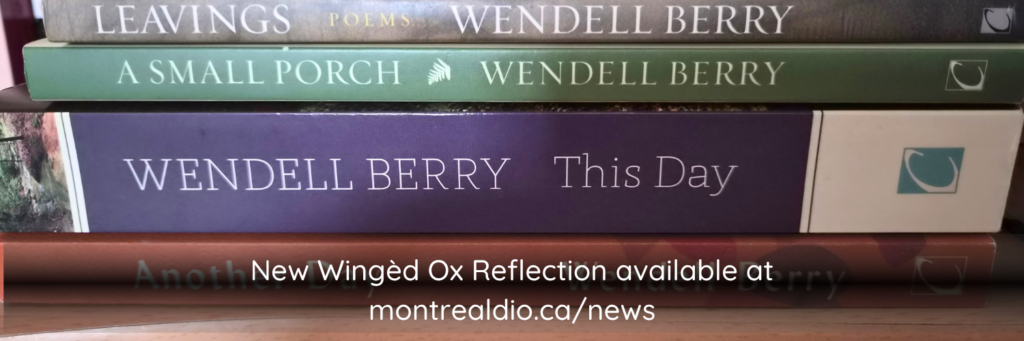
This reflection was written by the College’s principal, the Rev. Dr. Jesse Zink, for this week’s Wingèd Ox, a weekly news digest distributed to the college community. You will find reflections from previous weeks here.
Wendell Berry, who died last Monday at the age of 92, was an unusual person to make an impact on the church—but judging from what I saw church people writing about him in the wake of his death, his impact was significant.
Berry was born in the American state of Kentucky and spent part of his youth in places well beyond Kentucky—California, New York, Italy—in education and exploring the world. He was a bright and talented young man and had a world of opportunity before him. At age 30, however, he and his wife returned to rural Kentucky—the community of Port Royal—where they spent the rest of their lives on a farm. In addition to farming, Berry was an author of novels, essays, and poems. Not all of these stand the test of time, but much does, and it is through this writing that he exercised such immense influence. Berry did all this while also refusing the (alleged) conveniences of modern technology. One of his more noteworthy essays is “Why I Am Not Going to Buy a Computer.”
Berry was grounded in the church—even as he was critical of the institutional church, particularly the way it devalues rural and small communities—but his writings express a relationship with God that goes well beyond the church building. I want to share with you just a couple of the themes in his writing that have spoken to me—and many others—over the years.
Membership: A foundational word for Berry is membership. It refers to the people who belong to a community and, in Berry’s understanding, it is the memberships we claim that structure our identity. This notion of membership for Berry cut against the drive for individuality and individual self-fulfillment that he saw in so many other places. It is, of course, a deeply Biblical word: Paul tells us that we are members of the body of Christ. What are the memberships you are a part of that structure your identity?
Place: For Berry, being committed to a place is how we make our lives. This was obviously something he demonstrated in how he shaped his life. He was concerned how the pressures of the modern world disconnect us from specific places and instead lead us into more amorphous global linkages. While these can have many benefits, they take us away from what he thought should ground our identity. One essay of his that I find provocative and which I have assigned to some of you is titled “The Futility of Global Thinking.”
Land: As a farmer, Berry was of course deeply related to the land. But the land—a particular patch of God’s Creation—was for him not just something to be worked to generate income but a way of structuring his approach to the world. Berry saw himself as one part of a broader community of creation and he thought it vital to spend as much time in that creation, learning from it. Many of his poems, including “The Peace of Wild Things,” come from being on the land.
There’s lots more to say about Wendell Berry. In closing, I commend to you his 1973 poem “Manifesto: Mad Farmer Liberation Front,” which contains a number of wonderful lines, including these: “So, friends, every day do something / that won’t compute. Love the Lord. / Love the world.” It ends with a command we can all take to heart in the wake of Berry’s death and as we live amidst the power of death in the world around us: “Practice resurrection.”
Faithfully yours,
Jesse Zink
Principal