

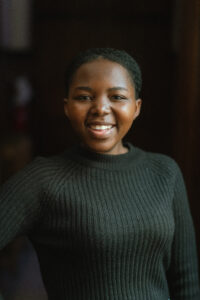
Born and raised in Rwanda until the age of twelve, Sabrina came to Canada carrying a strong faith, a close-knit family history, and ambitious academic goals. Her undergraduate studies in transnational law and human rights seemed to point toward a future in the legal profession. Yet as graduation approached, she found herself asking deeper questions about purpose, calling, and the direction of her life. What followed was a series of unexpected turns that led her down a path she never anticipated. Looking back, Sabrina sees those moments not as coincidences, but as signs of God’s guidance.
Faith was present in Sabrina’s life from an early age. Growing up in Rwanda, she spent much of her childhood surrounded by family. Her grandmother, a natural healer and a devoted Catholic, played a particularly important role in the household. More than a grandmother, she served as a guiding presence and spiritual influence for the family. Alongside her cousins, Sabrina occasionally attended Mass and was introduced to the practices of Christian faith. Yet, as she reflects today, her understanding of God at the time remained limited. “I knew of God,” she recalls, “but I didn’t know God deeply.” That relationship would begin to change after her family immigrated to Canada.
The experience of moving to a new country brought new challenges and opportunities. As Sabrina adjusted to life in Canada, her faith began to take on a more personal dimension. Prayer became increasingly important. God was no longer simply someone she heard about through family traditions or church attendance. Instead, God became a real presence in her daily life. “My relationship with God started becoming closer,” she says. “Very real.” The change deepened further when she moved to Montreal several years ago. It was there that she made a conscious decision to commit her life more fully to God. “I know there are other gods out there,” she remembers thinking, “but this is the God that I will serve.” That commitment would eventually shape decisions she never expected to make.
For much of her academic life, Sabrina imagined a future in law. Her studies focused on transnational law and human rights, and she believed that a legal career would allow her to advocate for others and make a meaningful difference in the world. The path made sense. She enjoyed building arguments, analyzing facts, and defending people. Law seemed like a natural fit for her talents and interests. Yet during her final year of undergraduate studies, something began to shift. As graduation approached, Sabrina started reflecting on questions she had rarely considered before. “Who sent me here?” she found herself wondering. While she had carefully planned her education, she realized she had spent little time asking God how her gifts and talents might be used. At the same time, the motivations that had once driven her toward law seemed less compelling. She wasn’t inspired by status. She wasn’t motivated by money. Instead, she found herself increasingly drawn to relationships, counseling, and understanding people. “I love counseling. I love relationships. I love anything mental, anything psychology,” she explains. Psychology began to look like a more natural fit than law.
There was only one problem: every attempt to change direction seemed to hit a wall. As Sabrina explored her options, she became determined to pursue psychology. Yet for reasons she still finds difficult to explain, the transition never seemed to work out. Wanting simply to continue her studies, she looked at programs she could enter quickly. The choices eventually narrowed to two possibilities: engineering or religious studies. The decision seemed obvious. “I was definitely not going to do engineering,” she jokes. Religious studies became the practical choice, though Sabrina initially viewed it as a temporary solution. Her plan was simple: enter the program and switch to psychology as soon as possible.
Then another unexpected challenge appeared. The program required a letter of intent. At first, Sabrina struggled. She couldn’t honestly write that theology was her lifelong dream. Yet she also didn’t want to misrepresent her intentions. Caught between those options, she turned to prayer. “Lord, guide me,” she prayed. “Give me what to say.” As she began writing, something surprising happened. Thoughts and motivations she had not fully recognized before started taking shape on the page. She realized that despite years of Christian faith, she had never studied her faith in an academic setting. She had long wanted a deeper understanding of Christianity, theology, and the questions that had shaped believers for centuries. The more she wrote, the more authentic the letter became.
Although she initially planned to change programs quickly, theology began having an unexpected impact. As her studies progressed, Sabrina discovered a genuine passion for theological learning. Courses that she had entered somewhat reluctantly became opportunities for growth, challenge, and deeper faith. “I learned so much,” she says. The experience gave her a new understanding of Christianity and revealed dimensions of faith she had never explored before. Far from being a detour, theology became a meaningful part of her journey.
Even now, Sabrina remains open to where God may lead next. She does not claim to have every answer or a perfectly mapped-out future. Instead, she continues to approach life with curiosity, trust, and a willingness to follow God’s direction. Today, Sabrina still asks God many of the same questions. Where is this path leading? What comes next? How will theology shape her future? Those answers are still unfolding.
What she does know is that theological study has strengthened and informed her faith in ways she never expected. Whether it ultimately becomes a career, a ministry, or simply an important chapter in her life, she believes the experience has already transformed her. “I trust God and where he leads me,” she says. Her story is a reminder that vocation is not always discovered through careful planning. Sometimes it emerges through unexpected opportunities, prayerful reflection, and the willingness to follow a path we never intended to take. For Sabrina Umumerwa, what began as an attempt to find the right academic program became something much more: an invitation to trust God’s plan, even when the destination remains unknown.